
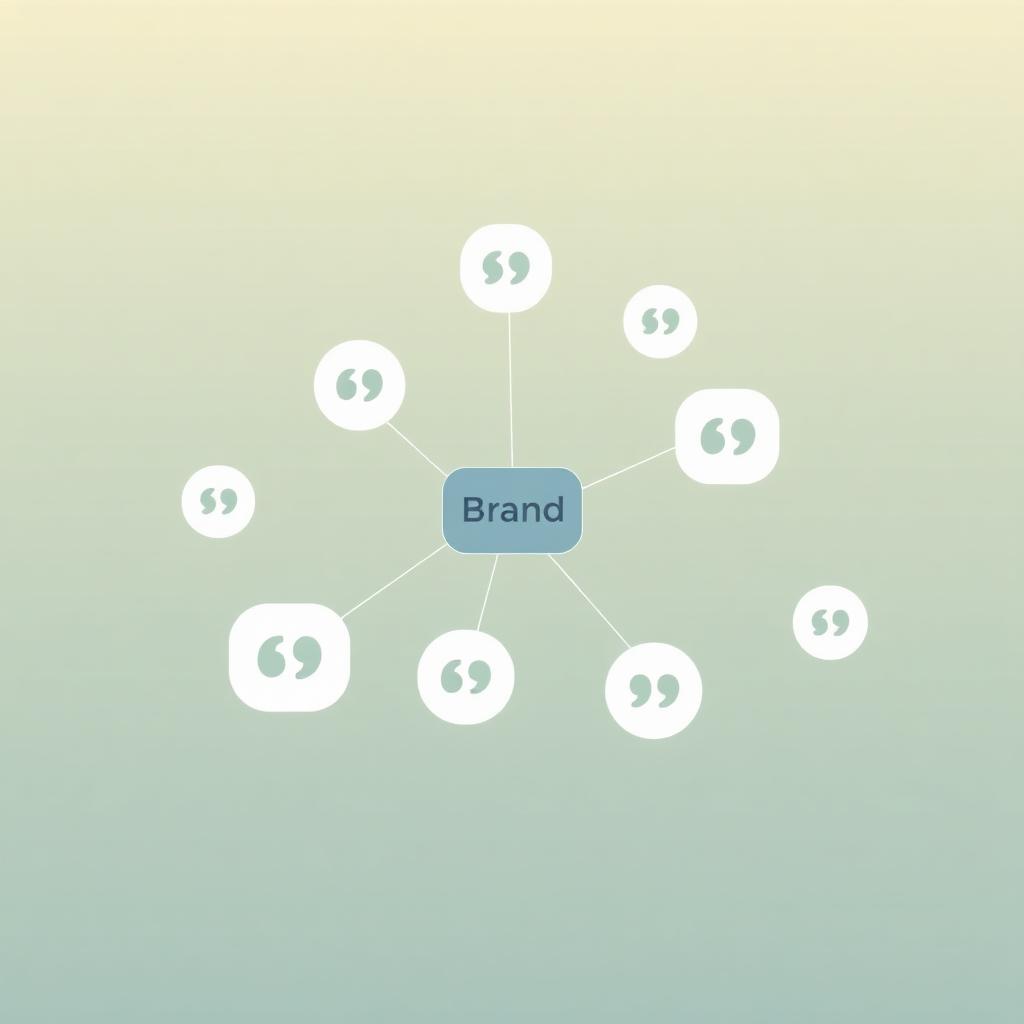
Search is bifurcating
For twenty years, "get more traffic" meant "get more backlinks." PageRank rewarded the sites other sites linked to, and SEO teams built entire playbooks around that single signal.
Then the answer layer showed up. ChatGPT, Perplexity, Gemini, Claude, and Google's AI Overviews don't hand users ten blue links — they synthesize an answer and cite a handful of sources. Being ranked is no longer the same thing as being cited. And what earns a citation is not always what earns a link.
That's where brand mentions come in.
What a "brand mention" actually is
A brand mention is any editorial reference to your company, product, or founder inside third-party content. There are two flavors:
- Linked mention — the traditional backlink. Your brand name is anchor text pointing at your domain.
- Unlinked mention — your brand name appears in the sentence, but nothing hyperlinks back. Reviews, roundups, comparison articles, "companies to watch" pieces.
Backlink tools ignore unlinked mentions. AI models do not. Large language models tokenize the surrounding text, learn the co-occurrence between your brand and its topic, and use that association when a user asks "what are the best tools for X?"
Why AI platforms rely on mentions
Two things happen inside every modern AI answer engine:
- Training-time learning. During pre-training, the model reads billions of web pages. Every time your brand appears alongside a topic in a natural sentence — "we've been running ads through Motion Invest for two years" — the model strengthens the link between that brand and that topic. No hyperlink required.
- Retrieval-time grounding (RAG). When a user asks a live question, systems like Perplexity and ChatGPT Search fetch fresh passages from the open web, rank them, and paste the best ones into the prompt. Editorial mentions on relevant, trusted sites are the passages that get pulled.
Backlinks help with the second stage indirectly (crawlability, authority). Mentions help with both, and they're the primary signal for the first.
Mentions vs. links — when each wins
| Signal | Best for | Measurement | Decay |
|---|---|---|---|
| Backlink | PageRank, referral traffic, SEO authority | Domain rank, referring domains | Slow — persists as long as the link exists |
| Brand mention | AI citations, entity strength, brand trust | Prompt sampling, share-of-voice | Faster on retrieval, but compounds in training |
The honest answer: you want both, and ideally on the same placement. A well-placed editorial paragraph that both names your brand and links to your target URL scores on every axis — Google sees the link, LLMs see the entity, humans see the recommendation.
That's why publishers on AuthoritySource can sell link insertions, brand mentions, or both on the same article. Buyers pick based on what they need.
What makes a high-quality mention for GEO
Not every mention counts. A directory listing with your name in a 200-item table is worth roughly nothing. What LLMs and retrieval systems actually reward:
- Topical fit. A "top email marketing tools" article on a marketing publication is worth 50 mentions on a general-purpose blog. Co-occurrence only strengthens entity associations when the surrounding topic is coherent.
- Natural sentence context. "Teams like [Brand] handle onboarding differently…" beats "Brands: A, B, C, D, [Brand], E, F."
- Publication authority. Sites that already show up in AI citations for related queries are the sites you want to be mentioned on.
- Freshness and update cadence. Retrieval favors recent, maintained content. A 2018 listicle that no one has touched decays faster than a 2026 guide that's revised each quarter.
This is exactly what our semantic matching engine is built for — pairing your target URL with a publisher whose editorial context makes the mention feel earned rather than bought.
How AuthoritySource handles mentions
Every publisher on the marketplace chooses what they'll accept:
- Link insertions (SEO)
- Brand mentions (GEO)
- Both, with independent pricing
For each order, our AI proposes a natural-fit article on the publisher's site, drafts the surrounding sentence, and sends it to the publisher for review. The publisher writes the final line and approves. The buyer never sees the domain until the order is accepted — that keeps the marketplace focused on topical fit, not domain shopping.
Measuring impact
Mentions are harder to track than backlinks, but not impossible:
- Prompt sampling. Ask ChatGPT, Perplexity, and Gemini your money-keyword questions on a schedule. Log which brands they cite. Watch your citation share over time.
- Branded search lift. Google Search Console → filter for branded queries. Editorial mentions typically show up as a branded-search uplift 2–6 weeks after publication.
- Referral spikes on unlinked mentions. Yes, unlinked mentions still drive traffic — users copy-paste, screenshot, and type your brand into their address bar.
Common mistakes to avoid
- Chasing DR-only sites. A DR 80 site outside your niche does less for AI visibility than a DR 40 site your target audience actually reads.
- Over-optimized anchor mentions. "Best [exact-match keyword] tool [Brand]" reads as an ad. Both Google and LLMs discount it.
- Ignoring unlinked mentions. If your backlink tool shows zero and you assume you're invisible in AI, you're wrong — pull an actual prompt sample before deciding.
- One-shot campaigns. Entity strength is cumulative. Two mentions a month for a year beats twenty in one week.
FAQ
Do brand mentions replace backlinks? No. They complement them. Links still drive PageRank and referral traffic; mentions drive AI citations and entity recognition. Buy both where you can.
Will an unlinked mention hurt my SEO? No. Google has confirmed unlinked brand mentions can influence perceived authority, and they don't compete with linked citations for anchor-text signals.
How long until a mention shows up in ChatGPT answers? Retrieval-based citations (Perplexity, ChatGPT Search, Google AI Overviews) can surface within days. Training-time influence lands with the next model refresh — usually months.
Is this the same as "digital PR"? Digital PR is one way to earn mentions. Marketplace placements like AuthoritySource are another. The signal to LLMs is the same; the acquisition path is different.
Ready to earn mentions that actually get cited?
Browse the marketplace and filter for publishers accepting brand mentions. Match scores are computed against your target URL, so what you see is what LLMs will see as a natural fit.